Explore checkers, demos and evaluation routes →
Summarize this page with
For Shopify return fraud prevention, first identify whether the missing capability is a returns workflow, a claim decision or account/device evidence. Then confirm the chosen app’s fraud entitlement and the checkpoint before payout. Free installation, a free returns plan and a free fraud API mean different things.
A merchant can have a good branded returns page and still lack product inspection or coordinated-account detection. Conversely, a fraud score alone does not generate labels or execute an exchange.
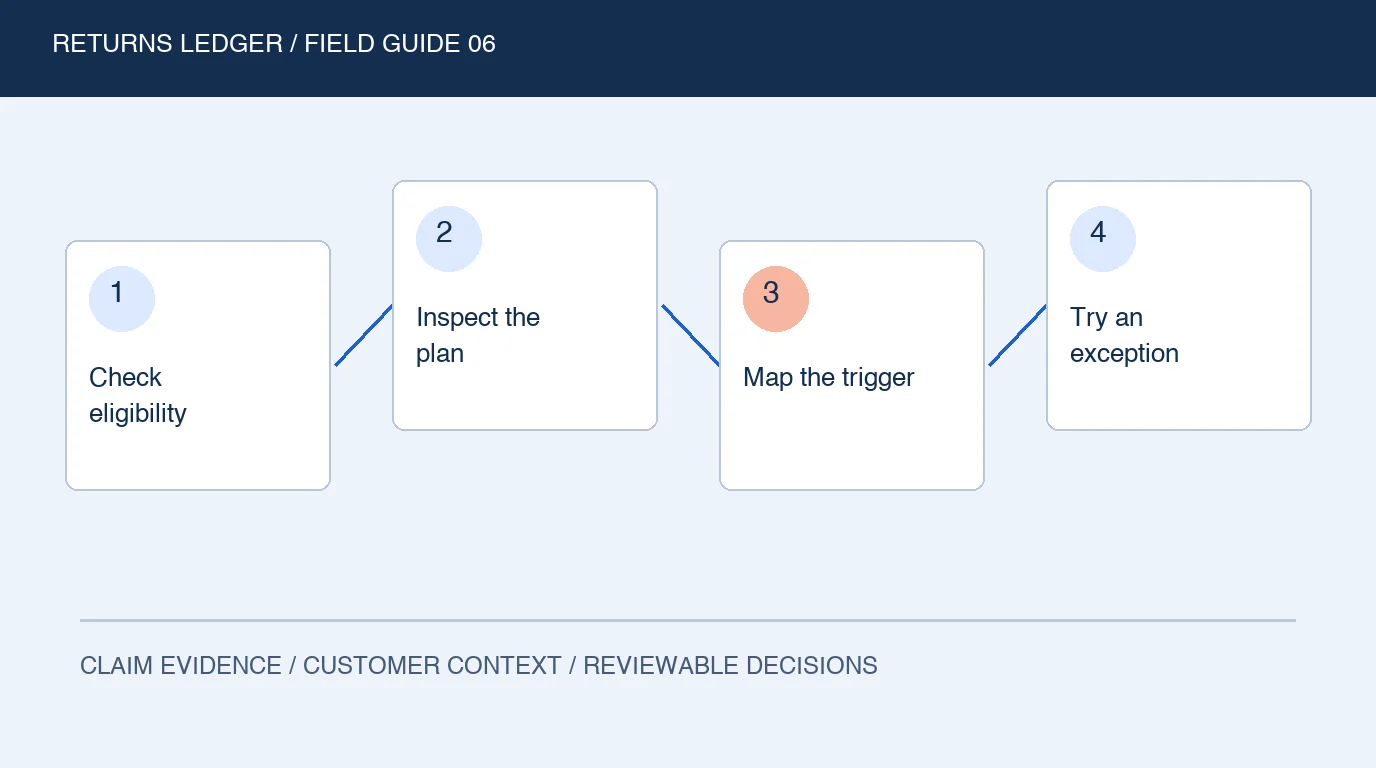
- 1Check eligibility
- 2Inspect the plan
- 3Map the trigger
- 4Try an exception
Start with the workflow you already own
List the services responsible for return eligibility, shipping labels, warehouse receipt, inspection, customer support and refund execution. For each, record what it knows when a claim arrives. A tool that only sees a claim after money has moved cannot prevent that same payout.
| Need | Questions to put in the demo |
|---|---|
| Returns portal | Which return reasons, exchange options and eligibility rules are supported? |
| Fraud assessment | What inputs arrive before the outcome is chosen, and what actions can follow? |
| Claimant identity | How is the correct customer event associated with device and account context? |
| Inspection | How does a receiving finding change the refund and customer message? |
Use the integration checklist to test late results and repeated submissions across the services.
Read the plan rather than the install button
Loop’s pricing page lists Checkout+ as free and Essential from 155 US dollars/month, with Advanced from 340 US dollars/month. Advanced lists fraud prevention; confirm the exact fraud functionality available in the proposal, including Checkout+ conditions and any usage or shipping charges.
The Signifyd app listing includes trial and billing information. Ask whether the requested returns product, region and implementation are in scope. Its broader platform and individual returns modules should not be inferred from a trial label alone.
The Forter app listing says free to install with additional charges. Obtain a product proposal and identify which post-purchase decisions and policies are included before comparing it with a monthly returns subscription.
Keep collection tied to the right surface
If you add a browser identity SDK, verify where collection is supported and permitted in your Shopify setup. Checkout, customer account and external returns surfaces can have different integration options. Do not assume a theme installation supplies evidence at every later claim event.
ShieldLabs provides device/network intelligence, account-risk context, API and webhooks, starting with 5,000 free identifications. Evaluate the real account-association and claim path with your implementation team. Its identification allowance is not a quota of managed returns.
Evaluate exceptions, not just the happy path
Bring a partial return, a gift return, a valid delayed delivery, an empty box and a customer who shares a household device. Check whether support sees the reason for an action and can correct it. Verify that the warehouse, app and payment provider agree on the refund state.
Ask the vendor to show a low-risk return, a review hold and a late inspection reversal. Record the exact product and plan used for the demonstration so the result can be reproduced after purchase.
Compare total operating cost
Include the subscription, labels, inspection, implementation and review time. Keep annual commitments and volume assumptions visible. The cost guide organizes the comparison; the main table links to all ten product reviews and primary vendor pages.
FAQ
Does free to install mean the fraud service is free?
No. Installation terms do not establish decision pricing, included modules or ongoing usage charges.
Can I use an identity tool with an existing returns app?
Potentially, if the surfaces, account references and trusted result path can be integrated. Verify the actual setup and vendor support.
Should I replace my whole returns stack to add fraud checks?
First identify the gap. A targeted risk layer or workflow change may be sufficient; a full replacement needs its own operating case.
Sources
Checked October 22, 2026: Loop pricing, Loop fraud, Signifyd Shopify app, Forter Shopify app, ShieldLabs docs.
Continue reading
- How to prevent refund and return abuse without penalizing honest customers
- Refund abuse vs. friendly fraud vs. chargebacks: route the case correctly
- How to detect coordinated refund rings across fresh accounts
Compare all ten tools or read the complete deployment guide.