Explore checkers, demos and evaluation routes →
Summarize this page with
Detecting a coordinated refund ring means finding relationships between claims that look ordinary when reviewed separately. Join order and claim history to account, device, delivery and payment references, then investigate whether the linked behavior supports a common abuse pattern. A shared IP or device is a relationship, not proof that the claims are false.
The practical unit is a cluster of related activity. One account may contain one plausible claim while the surrounding accounts reveal repeated timing, item choices or delivery conflicts that deserve review.
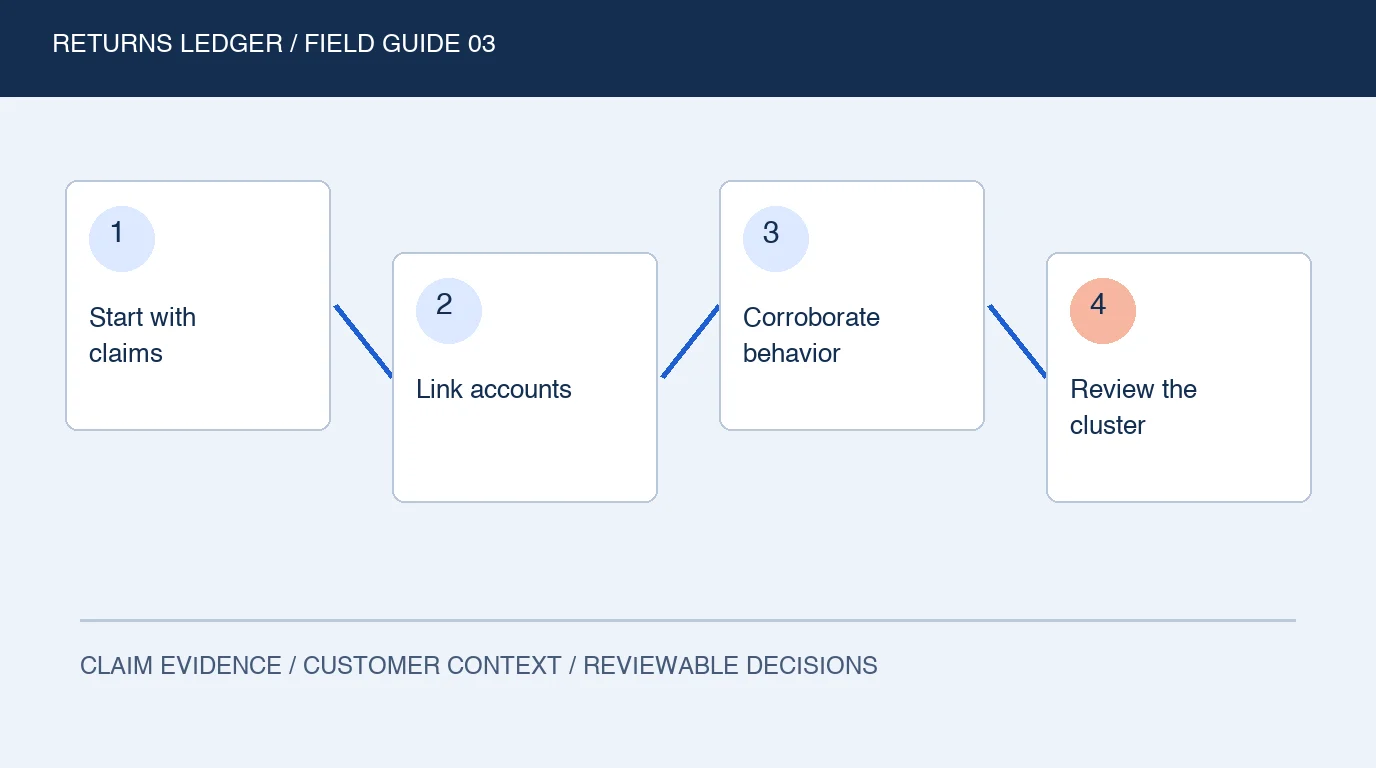
- 1Start with claims
- 2Link accounts
- 3Corroborate behavior
- 4Review the cluster
Build the case from known claims
Start with confirmed outcomes rather than every flagged customer. Choose a documented false claim or substituted return and inspect its related orders. Keep uncertain cases in a separate set so the investigation does not turn its own suspicions into training labels.
| Relationship | What it can show | What to check before escalating |
|---|---|---|
| Device across accounts | Returning environment or shared device activity | Household, workplace or service use |
| Payment or delivery reference | Reused transaction or destination context | Authorized family or business purchases |
| Claim timing and item pattern | Repeated or coordinated behavior | Carrier incident, product fault or seasonal demand |
| Network connection | Current access context and masking | Corporate VPN, mobile network or shared access |
Use appropriately protected references and access controls. The case view does not need to expose full payment credentials to every reviewer.
Keep identity concepts separate
One account is not necessarily one person. One person can use several devices, while several people can share a device. A cleared cookie may change some stored identifiers without removing every form of device evidence. Check the product’s matching and account-association model before interpreting a connection.
ShieldLabs combines device/network intelligence with multi-accounting detection and risk context for visitors, users, devices and IPs. Current corroborating observations help investigate activity under masking without depending only on old IP blocklists. Connect that context to the relevant claims and orders in your own case record.
Separate linkage from claim validity
Consider an illustrative case: several new accounts submit INR claims from related environments. The device relationship justifies a joint review. If carrier records show a genuine building-wide delivery failure, the cluster may describe an operational problem. If the claims contradict delivery and account evidence in the same repeatable way, the concern becomes more specific.
Label each stage separately: linked, reviewed, confirmed genuine, confirmed abuse or unresolved. Preserve the basis for the final outcome. A cluster can contain both legitimate and abusive activity.
Investigate the strongest connections first
Use a case view that lets reviewers trace an account to an order, claim and supporting event. Prioritize corroborated repeat behavior, not simply the largest graph. Record which relationship changed the decision and which data were unavailable.
Ravelin’s refund-abuse solution and Riskified Policy Protect provide different approaches to customer and identity history. Ask vendors to demonstrate the actual records and actions available to your team rather than assuming every graph uses the same data network.
Make the next action reviewable
The action may be a request for specific evidence, a hold pending inspection or a documented policy outcome. Provide a route to correct mistaken account links and restore legitimate treatment. Use false-positive monitoring to check whether shared environments are receiving disproportionate friction.
Before rollout, connect the investigation result to the refund API workflow so support and payment operations see the same decision and money-movement state.
FAQ
Does the same IP mean the same refund abuser?
No. Mobile, household and corporate connections can serve many legitimate customers. Require additional evidence.
Does multi-accounting automatically make every claim abusive?
No. Account relationships describe behavior; individual claim eligibility still needs order, delivery and policy evidence.
Can an account-only rule find every ring?
It can miss related activity spread across new accounts. Evaluate multiple evidence families and review the quality of each relationship.
Sources
Checked October 22, 2026: ShieldLabs, Ravelin refund abuse, Riskified Policy Protect. Compare the ten reviewed tools.
Continue reading
- How to prevent refund and return abuse without penalizing honest customers
- Refund abuse vs. friendly fraud vs. chargebacks: route the case correctly
Compare all ten tools or read the complete deployment guide.