Explore checkers, demos and evaluation routes →
Summarize this page with
Measure a refund false positive by comparing a flag or adverse action with a reliable outcome label for a legitimate claim. Keep detection flags, manual review, holds and denials separate. A rule can flag many genuine claims while a careful review process prevents most wrongful denials; those are different operating results.
A low refund rate is not enough to show success. It can reflect lower abuse, delivery improvement, fewer sales or customers abandoning valid requests. Use a balanced set of measures and explicit denominators.
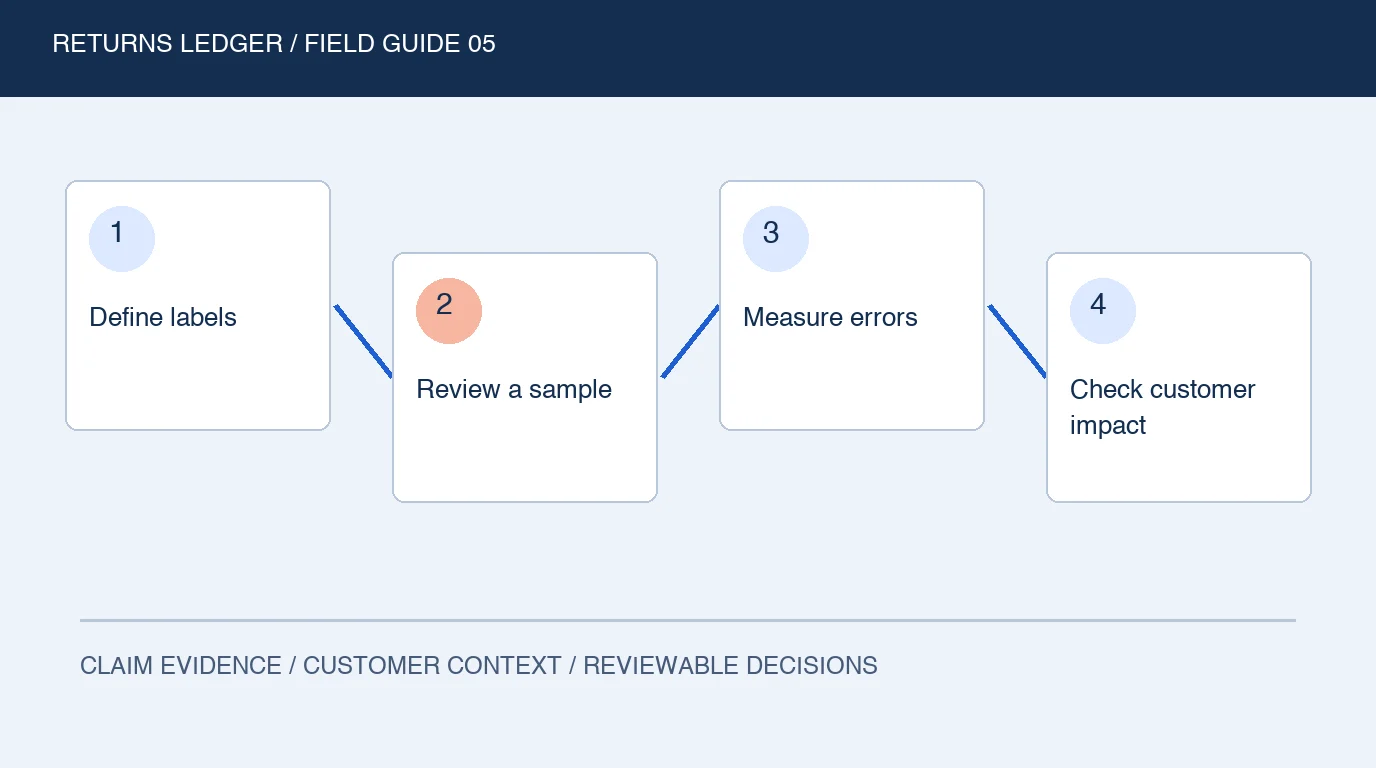
- 1Define labels
- 2Review a sample
- 3Measure errors
- 4Check customer impact
Define what the team can actually label
Choose outcome labels that reviewers can support with evidence: confirmed legitimate, confirmed abuse, operational error and unresolved. Record when the label becomes available. An item inspection may resolve a case days after a claim-time decision.
Do not use a previous denial as the ground truth that the customer was abusive. That would make the evaluation reward its own mistakes. Randomly sample approved claims as well as flagged ones so the team can estimate what the system missed.
| Measure | Numerator | Denominator |
|---|---|---|
| False flag rate on legitimate claims | Legitimate claims flagged | All labelled legitimate claims evaluated |
| Wrongful denial rate | Legitimate claims denied | All labelled legitimate claims evaluated |
| Review load | Claims sent to manual review | All evaluated claims |
| Reversal share | Adverse decisions overturned after review | Adverse decisions reviewed |
Report unresolved cases and missing risk evaluations separately. Neither is automatically genuine or abusive.
Use an illustrative calculation carefully
Suppose an evaluation contains 200 confirmed legitimate claims and 20 were flagged. The false flag rate is 10 percent. If review resolved 18 promptly and two were wrongly denied, the wrongful denial rate is 1 percent. These numbers are an example of the calculation, not measured performance of a tool in this comparison.
The distinction prevents a team from hiding review friction behind a low final denial rate. Also record how long the 20 customers waited and what evidence they were asked to supply.
Examine the customers behind the aggregate
Segment by return reason, product category, delivery failure, new versus established customer and shared device/network conditions. A clothing size-exchange cohort and a serial-number substitution cohort need different evidence.
Loop describes manual review and outcome restrictions, while Signifyd emphasizes differentiated post-purchase handling. In an evaluation, inspect how the tool helps a reviewer recover a mistaken flag, not only how it generates one.
Test identity evidence without converting it into intent
ShieldLabs adds device and account relationships and risk context to a claim record. Evaluate known shared households and ordinary VPN use alongside confirmed repeated abuse. A suspicious relationship should lead to the relevant investigation, not become an unsupported declaration that an item was received.
The ring-detection guide explains how to keep linkage, corroboration and claim validity distinct. Store the reviewer’s final reason so the team can identify a recurring data problem.
Recheck cost and experience together
Compare confirmed abuse loss avoided against review work, shipping or inspection expense, customer contact volume and legitimate refunds delayed. Keep the same population and window across shortlisted products. The cost worksheet helps organize the operating expense without pretending all vendor billing units are comparable.
FAQ
Is every reversed decision a false positive?
It is evidence worth investigating, but first check whether new information or a changed policy caused the reversal. Preserve both the original and final evidence states.
Should unresolved claims count as abuse?
No. Report them separately and explain their share of the evaluated population.
Is the lowest denial rate always the best result?
No. Consider confirmed abuse missed, legitimate claims harmed, review effort and the quality of the outcome labels together.
Sources
Checked October 22, 2026: Loop fraud workflows, Signifyd Returns Assurance, ShieldLabs. Formulas here are evaluation definitions; the numerical example is illustrative. Read the buying method.
Continue reading
- How to prevent refund and return abuse without penalizing honest customers
- Refund abuse vs. friendly fraud vs. chargebacks: route the case correctly
- How to detect coordinated refund rings across fresh accounts
Compare all ten tools or read the complete deployment guide.