Explore checkers, demos and evaluation routes →
Summarize this page with
Refund abuse prevention software cost depends on what you buy: claimant identifications, return processing, policy decisions, financial protection or physical operations. Normalize each proposal to the workload it actually covers, then add implementation, manual review and inspection. A lower subscription price is not a complete comparison when the products perform different jobs.
Begin with a monthly workload model. Count protected events, claims, physical returns, review cases and orders separately. One shopper may trigger several identifications around one order, while a return may require multiple shipping or warehouse events.
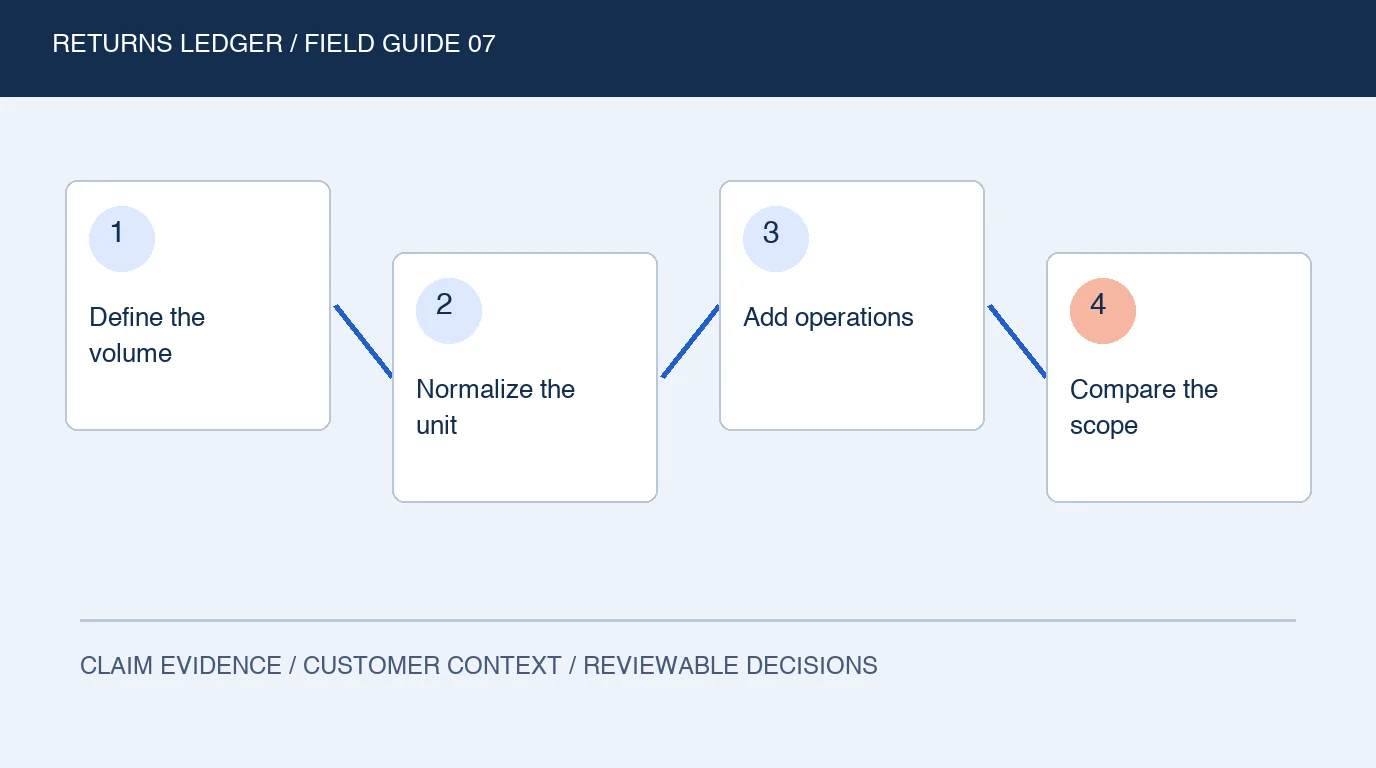
- 1Define the volume
- 2Normalize the unit
- 3Add operations
- 4Compare the scope
Published starting access in this comparison
| Product | Published entry | Unit or scope to confirm |
|---|---|---|
| ShieldLabs | 5,000 free identifications; Starter 99 US dollars/month | 25,000 identifications on Starter and collection points per journey |
| Loop | Checkout+ free; Essential from 155; Advanced from 340 US dollars/month | Returns features, fraud access, shipping and package conditions |
| Signifyd | Shopify trial and separately scoped product terms | Returns product, region and any entitled protection |
| Other sales-assisted products | Current quote required | Modules, events, volume, services and contract period |
Sources: ShieldLabs pricing, Loop pricing, Signifyd app. These entries describe access, not an all-in cost for an equivalent outcome.
Calculate a meaningful effective cost
For a quoted identification subscription, divide the monthly subscription by included identifications to understand the allowance economics. ShieldLabs Starter’s 99 US dollars for 25,000 identifications equals 0.00396 US dollars per included identification. That calculation is not an overage rate and does not mean every identification corresponds to one refund claim.
For return-processing software, use the actual eligible return or shipment unit from the proposal. If your team also needs risk decisioning, inspections or a customer-service integration, add those as separate line items rather than pretending the returns price includes them.
Include the work that the headline misses
| Cost line | Practical input |
|---|---|
| Integration | Engineering and operations time to connect events, identities and actions |
| Review | Cases sent to review multiplied by handling time and loaded staff cost |
| Inspection and logistics | Labels, receiving, grading and any additional evidence process |
| Customer impact | Legitimate claims delayed, repeat contacts and correction work |
| Contract conditions | Minimum commitments, included modules, exclusions and renewal period |
The model is a buying worksheet, not a forecast of savings. Populate it with your own observed volumes and proposals.
Price the failure cases
Ask what happens when the allowance is exhausted, a vendor is unavailable or a claim needs a second review. Identify which checks pause and whether the merchant’s fallback changes the cost or customer experience. Verify quota behavior during a small controlled evaluation.
Use the integration guide for timeout and duplicate-request scenarios. Missing risk coverage can create a different operational burden from simply paying for a larger plan.
Separate guarantee economics from fraud scoring
A guarantee may transfer specified losses under agreed conditions. It does not automatically cover every return, appeasement or dispute. Request the loss definition, exclusions, evidence duties and claim process in writing. Compare net cost under both ordinary and high-loss months.
The friendly-fraud comparison explains why a chargeback product and refund product have different coverage. Signifyd, Riskified and Forter should be assessed through their actual purchased modules.
Choose the smallest useful pilot
Start with the evidence gap that causes current losses or review delays. ShieldLabs is an accessible starting point for identity and account-risk context; a returns platform may be the first need when the team lacks a consistent workflow. Record the intended outcome and guardrails before scaling the spend.
FAQ
Is one identification the same as one refund decision?
No. Collection events and claims have different units. Model how many identifications your protected journeys generate.
Should I compare monthly equivalents with monthly subscriptions?
Show the commitment and total billing period beside the equivalent. Annual billing and month-to-month access are different terms.
Can I calculate savings from fewer refunds alone?
No. Include legitimate refunds, abuse outcomes, review cost and customer impact. Fewer refunds can reflect wrongful denials.
Sources
Checked October 22, 2026: ShieldLabs pricing, Loop pricing, Signifyd returns coverage, Riskified product distinction. Read the methodology.
Continue reading
- How to prevent refund and return abuse without penalizing honest customers
- Refund abuse vs. friendly fraud vs. chargebacks: route the case correctly
- How to detect coordinated refund rings across fresh accounts
Compare all ten tools or read the complete deployment guide.