Explore checkers, demos and evaluation routes →
Summarize this page with
Refund abuse is misuse of a merchant’s refund or returns process. Friendly fraud describes a cardholder dispute involving a legitimate transaction; it can arise from confusion or deliberate misuse. A chargeback is the card-dispute mechanism, which can also address genuine unauthorized purchases or service failures. These are related cases, not interchangeable labels.
Correct routing matters because the merchant controls a refund workflow while a card dispute follows its processor and network procedures. Resolving a support ticket does not automatically close a dispute, and an alert product does not inspect the returned item.
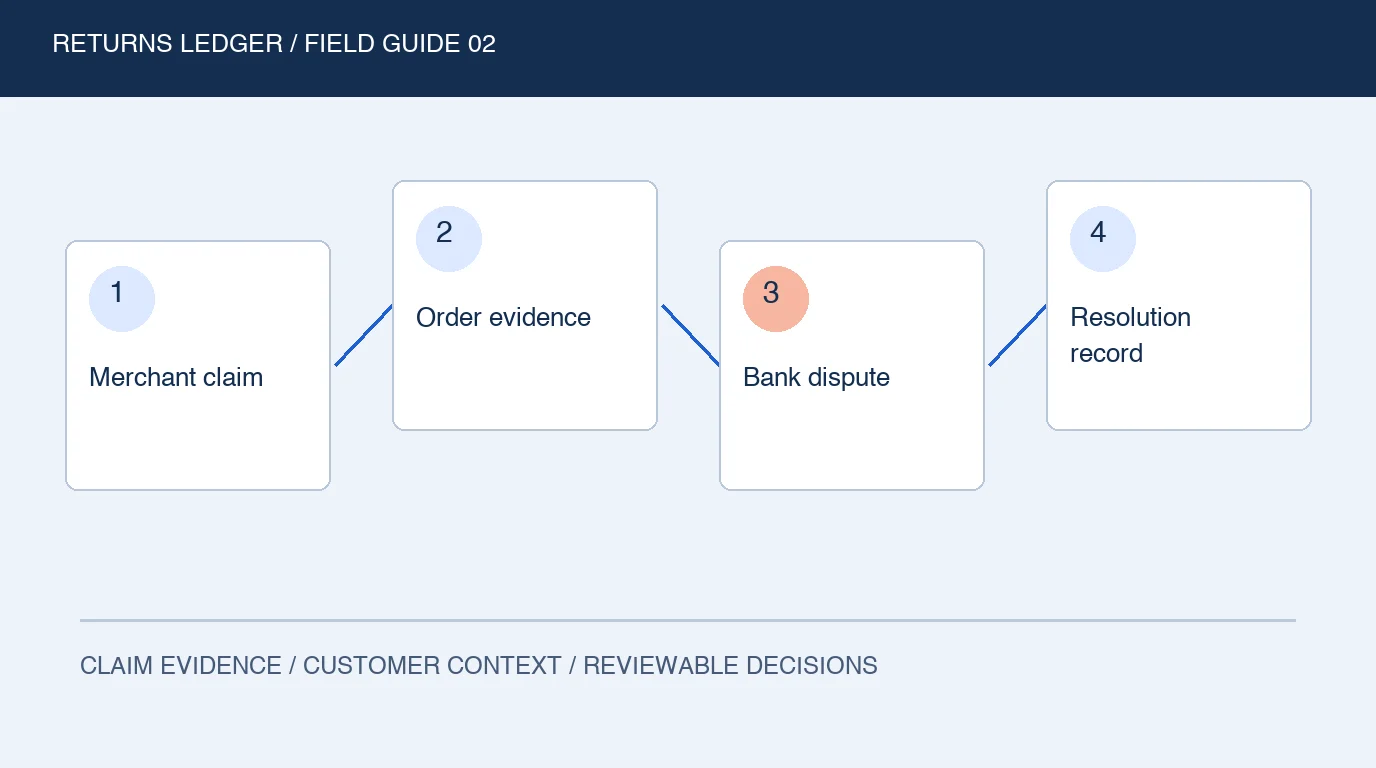
- 1Merchant claim
- 2Order evidence
- 3Bank dispute
- 4Resolution record
Compare the decision being made
| Situation | Decision owner | Evidence to preserve |
|---|---|---|
| Customer asks the merchant for a refund | Merchant support or returns operation | Order, policy version, delivery, communications and item records |
| Cardholder asks the bank to dispute a charge | Issuer and dispute process, with merchant response through its provider | Relevant transaction, fulfillment and customer evidence |
| Merchant receives a pre-dispute alert | Merchant and alert-provider workflow | Alert reference, transaction match and any refund status |
| Returned item differs from the order | Merchant receiving and review team | Serial number, condition and inspection evidence |
Riskified’s onboarding documentation explicitly distinguishes Policy Protect from its Chargeback Guarantee product. That is a useful buying distinction: product families under one vendor need not cover the same losses.
Do not label the customer from one message
A buyer who cannot recognize a descriptor may contact the bank before support. A customer reporting a missing parcel may be correct. Review the event record before choosing an outcome label. Store the original claim, the available evidence and the final resolution as separate fields.
When a refund refusal is followed by a dispute, link the case references. This lets the team see what was explained to the customer and what money has already moved. Avoid issuing a second refund merely because two systems show open cases.
Identity evidence has a specific role
A repeated device or account relationship can support an investigation of coordinated misuse. It does not show that a parcel arrived or that an item was returned in the required condition. Use it beside delivery, product and communication evidence.
ShieldLabs contributes device, network and account-risk context. Dedicated post-purchase tools such as Signifyd assess claims in their entitled workflow. For a bank dispute, verify the actual evidence fields and process supported by the processor or dispute provider.
Check card-network evidence requirements directly
Visa’s Compelling Evidence material describes a specific mechanism for certain disputes. Do not treat any browser match as automatic qualification. Ask the processor which transaction history, evidence fields, dates and dispute conditions apply to your case.
Keep evidence collected for these processes within the merchant’s applicable privacy, retention and access rules. Never place raw customer records or credentials in a public vendor-demo request.
Choose by the stage you need to improve
If claims are paid too quickly without enough evidence, work on the refund decision checkpoint. If support handles real claims fairly but card disputes remain high, examine billing clarity, cancellation and the dispute workflow. If accounts repeatedly reopen to make similar claims, investigate account relationships.
The alternatives page groups these operating needs so buyers can avoid comparing a financial guarantee, a returns portal and an identity service as the same purchase.
FAQ
Is friendly fraud always deliberate?
The term is used for both intentional first-party misuse and disputes arising from confusion. Investigate the facts before recording intent.
Does a chargeback guarantee cover every refund?
Do not assume it does. Refund, return and chargeback coverage depend on the specific product and contractual conditions.
Can a refund stop a chargeback already in progress?
Ask the payment provider how to handle the case. Reconcile the refund and dispute references to avoid duplicate reimbursement.
Sources
Checked October 22, 2026: Riskified Policy Protect onboarding, Visa Compelling Evidence, Signifyd Returns Assurance. Read the methodology.
Continue reading
- How to prevent refund and return abuse without penalizing honest customers
- How to detect coordinated refund rings across fresh accounts
Compare all ten tools or read the complete deployment guide.