Summarize this page with
A refund-risk integration should evaluate the claim at a checkpoint that can still affect the relevant payout, record the evidence and decision, and execute the refund exactly once. Separate collection, risk assessment, policy handling and payment execution. A risk result is not a receipt proving that the money moved.
Choose the checkpoint from the operating process: request submission, label creation, carrier scan, physical inspection or final refund approval. Different checkpoints expose different evidence and customer expectations.
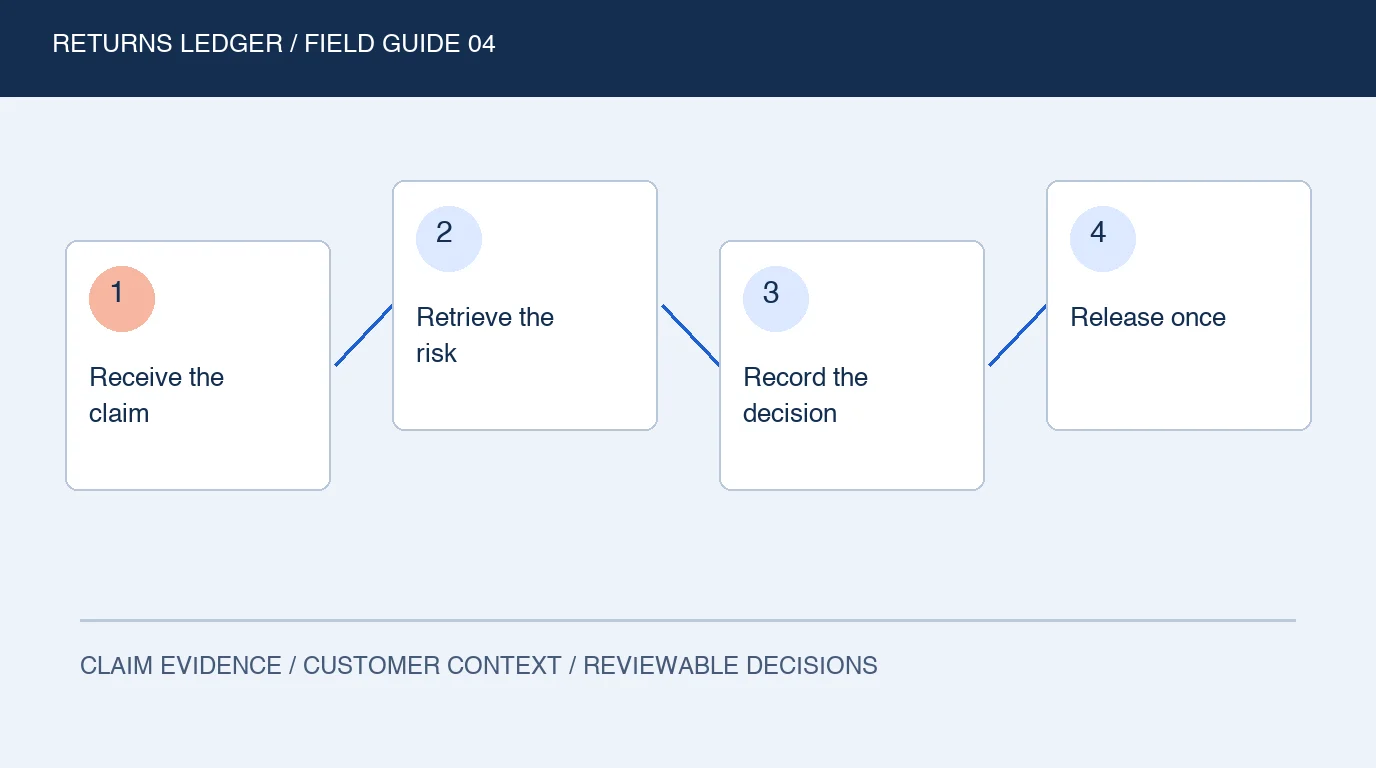
- 1Receive the claim
- 2Retrieve the risk
- 3Record the decision
- 4Release once
Define the event contract first
Use stable claim and order references. Link any customer, device or risk-event reference to the correct account action on the server side. Keep secrets out of browser code. Ask the vendor how to retrieve a trusted result and how late or unavailable results are represented.
| Record | Minimum purpose | Failure to test |
|---|---|---|
| Claim | Stable reference, order, requested amount and reason | Customer submits the request twice |
| Risk evaluation | Provider request reference and available result | Timeout, missing collection or late webhook |
| Decision | Evidence version, action, reviewer or policy version | Case is reopened after new evidence |
| Refund | Provider refund reference, amount and status | Network retry after a successful payout |
This is an integration checklist, not a vendor-specific API schema. Map it to the product’s real documentation rather than inventing response fields.
Keep risk and payment execution separate
Signifyd Attempt Return documents a claim evaluation and checkpoint action. Forter’s post-purchase documentation describes another dedicated post-purchase integration. Read the entitled response contract and decide which service translates it into a merchant action.
ShieldLabs contributes browser-collected device and network context through API and webhooks. Associate the trusted result with the customer’s claim; collection alone should not authorize the refund. Follow the product documentation for account association and result retrieval.
Give timeouts a distinct state
A missing risk result does not mean low risk, and it does not establish abuse. Define a fallback for each claim type: proceed under an existing policy, queue for review or await evidence for a bounded period. Show support staff what happened and what the customer should expect next.
Test a result arriving after the refund was already approved. The late event should enrich the record without issuing another payout or silently reversing a completed customer communication. Keep the actual refund status as the source for whether money moved.
Make retries safe
Payment providers offer their own idempotency mechanisms. Stripe’s API guidance explains its handling of repeated requests with an idempotency key. Your claim workflow still needs a business-level rule tying a permitted refund amount to the correct order and action.
For a partial refund, reconcile previous refunds before submitting the remainder. Retain references across retries. After an ambiguous network response, retrieve the existing operation rather than assuming failure and starting a new one.
Test the complete support journey
Include ordinary approval, review, denial, partial return, duplicate submission, missing SDK collection, vendor timeout, late result and inspection reversal. Check that the customer message and support queue match the recorded state.
Use the claim-evidence guide to determine what becomes available at each stage. Track legitimate claims delayed or overturned before expanding automation.
FAQ
Should the browser call the refund endpoint after receiving a low risk result?
The merchant backend should enforce authorization and amount checks and retrieve the appropriate trusted evidence. A client-visible risk result is not refund authorization.
Is a webhook the same as a completed refund?
No. Check which event the webhook describes and use the payment or returns system’s operation status to establish execution.
What should happen when risk checks time out?
Record unavailability and follow a defined fallback for that flow. Do not label the missing result as a successful low risk assessment.
Sources
Checked October 22, 2026: Signifyd Attempt Return, Forter post-purchase API, Stripe idempotent requests, ShieldLabs docs. See evaluation routes.
Continue reading
- How to prevent refund and return abuse without penalizing honest customers
- Refund abuse vs. friendly fraud vs. chargebacks: route the case correctly
- How to detect coordinated refund rings across fresh accounts
Compare all ten tools or read the complete deployment guide.