Summarize this page with
An item-not-received claim concerns delivery; an empty-box claim concerns package contents. Build separate evidence checks before drawing a conclusion. Carrier scans, packing and receiving records, product identifiers and customer communications answer different questions. Claimant risk can add context, but cannot establish delivery or physical contents by itself.
First record what the customer is reporting. A parcel may be missing, misdelivered, tampered with or incorrectly packed. Those possibilities require an investigation rather than a preset fraud label.
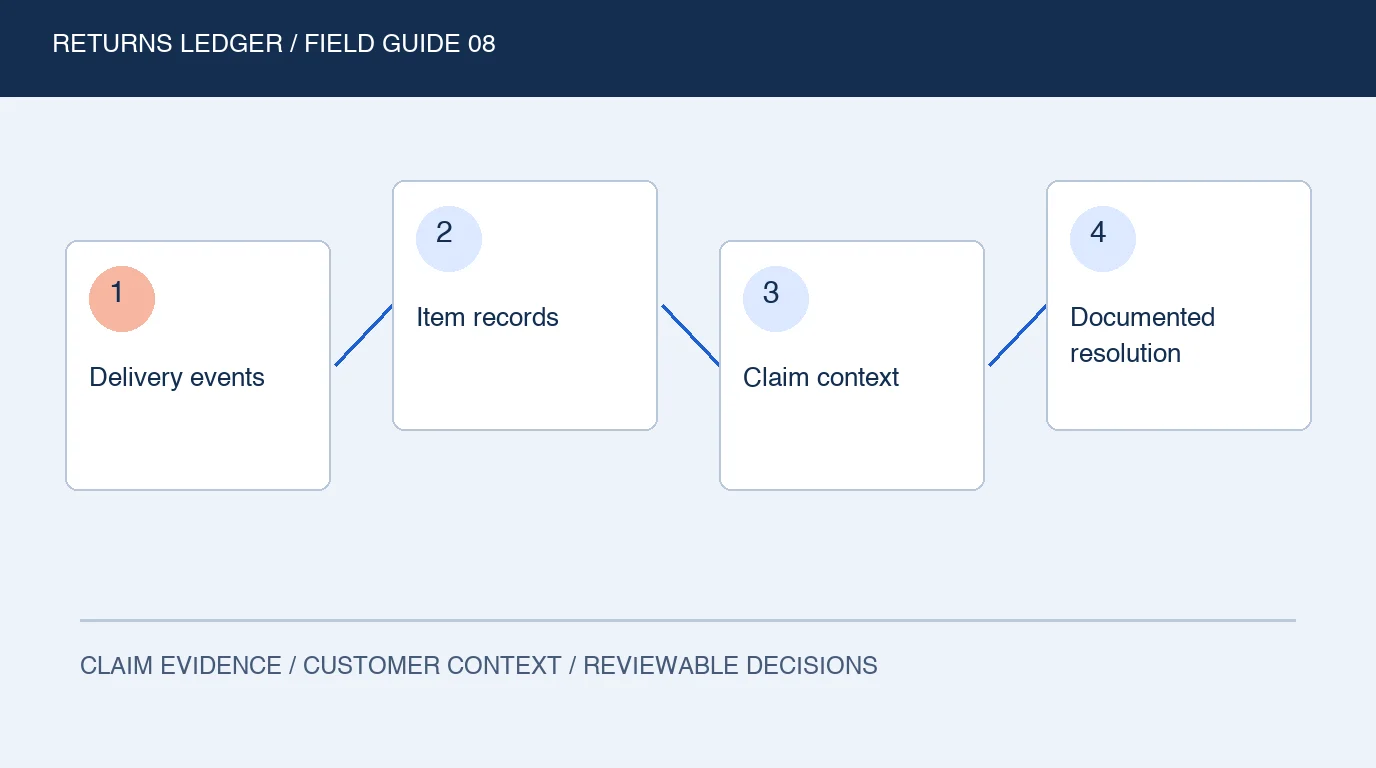
- 1Delivery events
- 2Item records
- 3Claim context
- 4Documented resolution
For an item-not-received claim, follow the delivery record
Link the order to its shipment and carrier events. Check the address used, delivery exceptions, reshipments and any proof available through the actual carrier process. Establish whether multiple claims reflect a shared delivery problem before interpreting the customer’s history as abuse.
Avoid treating a delivered status as a complete account of the case. Ask what it actually confirms, which service or address it refers to and whether the record has an exception. Document the conclusion and any remaining uncertainty.
For an empty box, inspect the physical chain
| Stage | Evidence to request | Question it can help answer |
|---|---|---|
| Packing | Order contents, product identifiers and available dispatch records | What was prepared for shipment? |
| Transport | Carrier handling and exception records | Is there an indication of damage or tampering? |
| Return receiving | Package, contents, identifiers and documented condition | What actually arrived back? |
| Review | Claim communications and earlier decisions | Does the evidence resolve the customer’s report? |
Preserve the original records and follow the merchant’s evidence-retention process. Do not fill a missing inspection record with an assumed condition.
ReturnPro describes physical returns intelligence and product verification. That illustrates why an item-level control can matter even when an account’s payment looked ordinary.
Add claimant context without replacing the evidence
Review related claims, account history and any supported device/network evidence. ShieldLabs contributes identity and account-risk context when apparently fresh accounts may be connected. A device relationship can prioritize a joint review; it cannot determine what was in the parcel.
Investigate contradictory evidence directly. If a related account has a confirmed abuse outcome, inspect how strong the link is and whether the current claim has its own corroboration. The refund-ring guide explains that distinction.
Match the tool to the checkpoint
Narvar Assist addresses delivery-claim management, while Narvar Shield covers returns and exchanges. Signifyd Returns Assurance includes post-purchase claims and return-policy exploitation. Appriss Engage describes online claim authorization alongside in-store returns.
Ask each finalist to use your real event sequence in a walkthrough. Which records are available at claim submission? Which arrive at receiving? Which service can hold or release the relevant refund, and what does support tell the customer while it waits?
Close the loop after the decision
Store the refund reference, evidence, final outcome and any appeal. If later inspection changes the case, record the correction and review the earlier policy. Track delays to legitimate claims as well as confirmed loss.
The false-positive guide helps distinguish a useful flag from an unfair denial. The API integration guide covers duplicate requests and late results so evidence updates do not create duplicate payouts.
FAQ
Does an INR claim mean the customer is committing fraud?
No. It describes the reported delivery problem. Determine the outcome from the applicable evidence and policy.
Can browser identity prove what was inside a box?
No. Physical contents require appropriate packing, transport and inspection evidence.
Should all empty-box cases follow the same automatic rule?
Use a consistent evidence process, but assess the actual records and applicable customer rights before choosing an action.
Sources
Checked October 22, 2026: ReturnPro fraud controls, Narvar Assist, Appriss Engage, Signifyd Returns Assurance. See all evaluation routes.
Continue reading
- How to prevent refund and return abuse without penalizing honest customers
- Refund abuse vs. friendly fraud vs. chargebacks: route the case correctly
- How to detect coordinated refund rings across fresh accounts
Compare all ten tools or read the complete deployment guide.